In The Eye of The Beholder
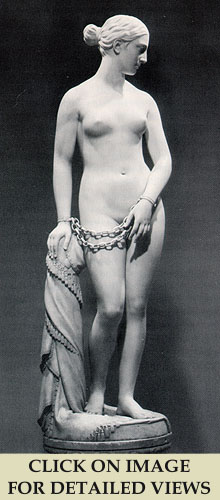
The Governor of Vermont has a lamp which replicates a statue, titled, "The Greek Slave," by Hiram Powers, a famous 19th century Vermont artist, on his desk.

According to the
Bennington [Vermont] Banner, the lamp-statue was recently installed as part of the Vermont State House restoration project. Even more recently the Governor told his staff to deep-six the thing. Two explanations have been offered. First, the governor is worried the statue could be broken. Second, the Governor doesn't want to explain to school children why he has a lamp-statue of a naked lady, who is in chains, on his desk. Vermont, we note, remains a state in which school children can reasonably expect to meet the Governor some time during their K-8 education.
Yesterday the Governor backed off his complaints about the statue's nudity, but insisted that his desk was no place for a lamp.
Liberals are having fun with this little imbroglio. A
group in Vermont, whose numbers include Sen. Jim Jefford's
wife, is rallying to save the lamp-statue's place of honor on the Governor's desk. Pudentilla confesses that her first reaction to the story was to think "the
John Ashcroft Memorial Idiocy about Art Award has found a home."
AMERICAblog opines "Perhaps it's time we called the governor and suggested he stop the jihad and start the educating."
Before we start the snark-fest, however, we might want to note some of the not uncomplicated aspects of the lamp-statue. First, it is not art. It is
kitsch. It is not the original, or one of the miniture replicas of the original made by Mr. Powers. It is not a replica of one of Mr. Powers' replicas. It is a lamp built on a base of a replica of Mr. Powers' replicas. The Governor of Vermont could have said, "get this tacky piece of kitsch off my desk," and Pudentilla might well have applauded him. But he did not. He said "get this statue of a naked lady off my desk before she's broken" (or words to that effect).
The original statue, itself, is not without its problematic aspects. Minus the lampshade, she looks like
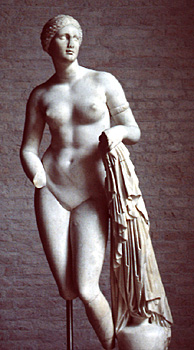
this. Powers model for "The Greek Slave" has been
identified as the
Uzzi Medici Venus. Pudentilla's partner, a hellenist, notes that "The Greek Slave" also recalls the famous "
Aphrodite of Knidos," the first monumental classical sculpture to depict a female nude.
Greek sculptors had depicted many a male nude before Praxiteles rendered Aphrodite. While these representations of the male body may well have aroused some sexual passion among male and female viewers, scholars have argued that the
nudity of the male in Greek sculpture is "heroic". Heroic nudity (the rendering of the nude male in contexts, like combat, where no male would ever appear nude) was a trope of Greek art that idealized the male depicted as something more than merely human. While Praxiteles may or may not have imagined a comparable heroic nudity for his Aprhodite (the decorous shielding of the pudenda suggests something more complicated was going on), we know that Powers intended to invoke pathetic, not heroic associations by his rendering of the female nude form. We know this because he told us so:
"The Slave has been taken from one of the Greek Islands by the Turks, in the time of the Greek Revolution; the history of which is familiar to all. Her father and mother, and perhaps all her kindred, have been destroyed by her foes, and she alone preserved as a treasure too valuable to be thrown away. She is now among barbarian strangers, under the pressure of a full recollection of the calamitous events which have brought her to her present state; and she stands exposed to the gaze of the people she abhors, and awaits her fate with intense anxiety, tempered indeed by the support of her reliance upon the goodness of God. Gather all these afflictions together, and add to them the fortitude and resignation of a Christian, and no room will be left for shame." (source page for quote)
Powers thus links his Slave's pathetic nudity to her Christian identity. The Christian audience masks its own voyeuristic pleasure in the experience by attributing that very pleasure to the Muslim Turk who observes the original. The Christian audience can thus misrecognize their own pornagraphic pleasure in the spectacle of the slave as justified outrage at the "barbarian" who so degraded the slave. The nudity is not heroic, it is "moral." (A better, more detailed argument is
here).
Which brings us to another complicated aspect of the lamp-staute on the desk of the Governor of Vermont. The original explicitly invoked the passions of the then recently ended Greek war for independece from the Ottoman Empire. That war, like another more recent war involving Christians and Muslims prompted, on both sides, extreme, violent language (and actions) that should trouble any modern student of the conflict between Islam and the West. We offer the following examples from Mr. Gyford's notes on Mark Mazower's book,
The Balkans.
The Balkans by Mark Mazower (Phil Gyford: Notes)
11 Edith Durham: “When a Moslem kills a Moslem, it does not count; When a Christian kills a Moslem, it is a righteous act; when a Christian kills a Christian it is an error of judgement better not talked about; it is only when a Moslem kills a Christian that we arrive at a full-blown atrocity.”
68-9 From mid 18th century Orthodox and Catholic relations worsened (with the rise of Catholic Austria and Orthodox Russia). 19th century - Greek and Serbian nationalist movements challenged Ottoman attitudes to Orthodoxy. From 1876 Islam defined as “the religion of state”. Reaction to Western “meddling” provoked more defensive and hardline Muslim attitudes.
76 “Religion became a marker of national identity in ways not known in the past.” No room for the anti-church secularism that emerged in Western Europe in the struggle against Catholicism."
The Greek Slave, which liberals are so earnestly defending, in other words, was created as part of a larger discourse which deliberately exploited a pornographic rendering of the female nude to arouse religious and racial hatred against Muslims. The Governor of Vermont, in other words, could have said, "get this racist, exploitative of women, kitschy lamp-statue off my desk. If we want to talk about religion, gender and war we need sensitivity not passion." But he didn't. He just didn't want a fragile lamp-statue of a naked lady in chains with a cross hanging in the drapery on his desk.
Which brings us to another complicated aspect of the lamp-statue. Abolitionists in Vermont adopted "The Greek Slave," as their symbol in the years before the Civil War. Thus this now morally difficult rendering of the inherent injustice of the enslavement of a white Christian woman by a dark Muslim man, became a figure through which white Americans could protest the inherent injustice of the enslavement of slaves of African origin in America. While Victorian Vermont liberals were blind to the historical context of "The Greek Slave" and thus could blithely ignore the layers of difficult and contradictory meanings her portrait offers, we cannot and should not be so indifferent to the history of an object we are celebrating for the history it represents.
The Governor of Vermont could have said, "This kitschy lamp-statue which erotically objectified women in service of a racist, christianist propaganda which was later overwritten by an abolitionist idealism is an ideal object for all of us to consider when we embark upon a discussion of religion, war, gender and race. And we should be having such discussions regularly since 9/11 and the war in Iraq. Get me a staffer to work up some talking points on how complicated and difficult such discussions are. Have her explain how objects like this lamp-statue demonstrate that history leaves none of us innocent and how guided by a rigorous examination of our own history we can evaluate the rhetoric and propaganda being deployed by and against us when we as citizens our called upon to make political decisions in our own day."
But he just wants the lamp-statue off his desk, so it won't break, and so third-graders won't ask him difficult questions. Another teachable moment down the drain.